ADP-3D
Solving Inverse Problems in Protein Space using Diffusion-Based Priors
Ellen Zhong , Gordon Wetzstein , Axel Levy
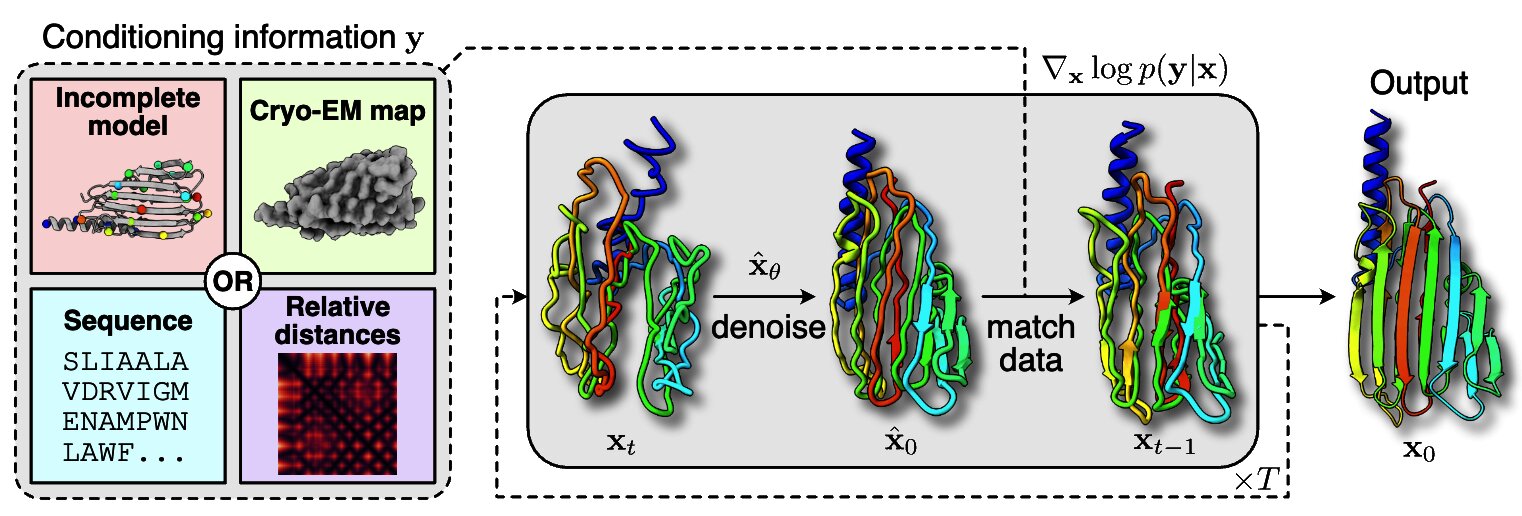
ADP-3D (Atomic Denoising Prior for 3D reconstruction) is a framework that conditions a diffusion model in protein space with any observations for which the measurement process can be physically modeled. Inspired from plug-n-play, ADP-3D demonstrates versatility in solving inverse problems in protein space with a pretrained diffusion model as a learned prior. It outperforms existing posterior sampling methods at reconstructing full protein structures from partial structures. It shows that a protein diffusion model can be guided to perform atomic model refinement in simulated cryo-EM density maps and that it can be conditioned on a sparse distance matrix. For more details, please visit the project page.
GitHub Repository
References
Solving Inverse Problems in Protein Space Using Diffusion-Based Priors
arXiv preprint arXiv:2406.04239 (2024)
The interaction of a protein with its environment can be understood and controlled via its 3D structure. Experimental methods for protein structure determination, such as X-ray crystallography or cryogenic electron microscopy, shed light on biological processes but introduce challenging inverse problems. Learning-based approaches have emerged as accurate and efficient methods to solve these inverse problems for 3D structure determination, but are specialized for a predefined type of measurement. Here, we introduce a versatile framework to turn raw biophysical measurements of varying types into 3D atomic models. Our method combines a physics-based forward model of the measurement process with a pretrained generative model providing a task-agnostic, data-driven prior. Our method outperforms posterior sampling baselines on both linear and non-linear inverse problems. In particular, it is the first diffusion-based method for refining atomic models from cryo-EM density maps.